The 6 weeks after the trade deadline are critical for playoff teams. This is where teams need to integrate their new players, decide on line combinations, and finalize their strategy for the playoffs. In a sport like hockey, where team chemistry can make or break a championship, it is vital to have an accurate assessment of the squad ahead of the post-season. In this post, I will take a look at teams’ and players’ statistics before and after the trade deadline, and evaluate the effect their deadline acquisitions had. This can help shed some clarity on if the acquisitions teams made have helped them improve their team, or improve the performance of particular players. Based on the results, I will also highlight the teams and players with the largest positive and negative changes from the trade deadline.
In this first section, let’s take a look at team-level statistics. My method revolved around 3 statistics: Corsi percentage, Fenwick percentage, and expected goals percentage. Corsi is the ratio between the number of shots taken over the number of shots allowed. This includes all shots, regardless if they were missed, blocked, or scored. Fenwick is similar to Corsi, but only includes shots that were unblocked. Expected goals percentage is the number of goals that were expected to be scored, based on shot placement, angle, power etc., over the number of goals that were expected to be conceded. All data for team level statistics was collected from Natural Stat Trick and included all situations in the game (powerplay, even strength, shorthanded).
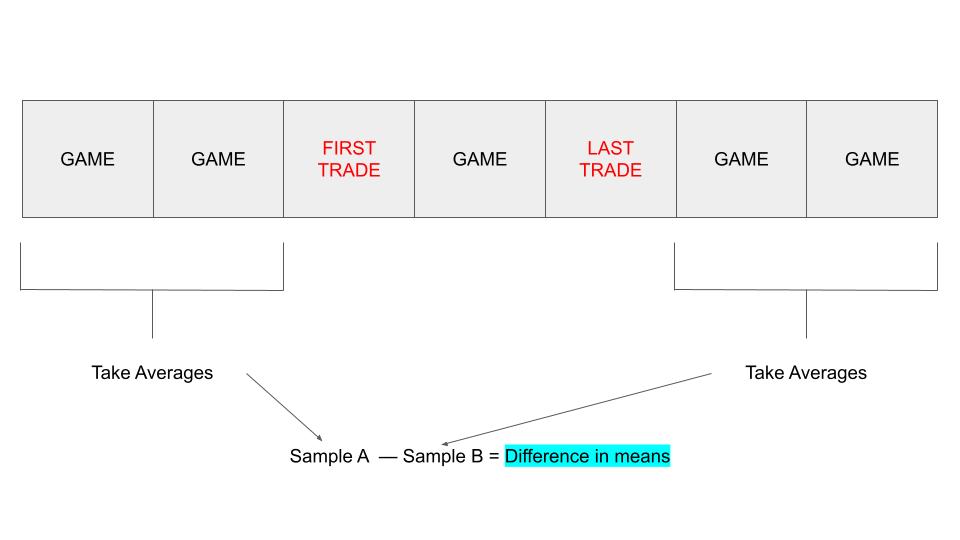
I considered the trade deadline period to start on January 30th 2023, when Bo Horvat was traded from Vancouver to New York. The end of the trade deadline was March 3rd 2023, which was the date set by the NHL. Since we want to consider the effect of all the transactions in that time frame, I collected game-level data for every game after each teams last transaction in the trade deadline period up to March 17th 2023. From this data, I collected the Corsi, Fenwick, and Expected Goals statistic from each game and took the average. I also counted the number of games each team had played after their last trade. This number was used to collect a number of games before each teams first trade during the trade deadline period. For example, if a team had played 5 games from March 3rd to March 17, then their 5 latest games prior to the trade deadline were selected. The Corsi, Fenwick and Expected Goals from these earlier games were also averaged. Finally, these two averages were subtracted to create a difference in means. They were also used to run a 2-sample t-test, to determine if the difference in means was statistically significant. The method I used is visualized below.
Biggest positive: Colorado Avalanche
| Team | Corsi % difference (p-value) | Fenwick % difference (p-value) | Exp. Goals % difference (p-value) |
| COL | 10.5% (0.03) | 9.44% (0.06) | 2.18% (0.70) |
Since the trade deadline, the Avalanche have really kicked it into high gear. Their difference in Corsi and in Fenwick were significant at the 90% confidence level (p-value less than 0.10). Their trade deadline moves involved the acquisitions of Lars Eller and Jack Johnson. While these are depth acquisitions, the Avalanche have been on a serious tear since the deadline. Recent injuries to Cale Makar and Arturi Lekhonen have not hampered them, as they’ve also gotten strong performances from players like Denis Malgin. They are also hoping to get captain Gabriel Landeskog, out on injured reserve, back for the playoffs. All signs point to the Avalanche peaking at the right time as they push into the playoffs, looking to defend their 2022 Stanley Cup title.
Biggest negative: Vegas Golden Knights
| Team | Corsi % difference (p-value) | Fenwick % difference (p-value) | Exp. Goals % difference (p-value) |
| VGK | -9.37% (0.01) | -9.34% (0.01) | -14.19% (0.01) |
The bigger story for the Knights during the deadline period was the injuries rather than the trades. Winger Mark Stone and goalie Logan Thompson were both put on injured reserve by the Knights during the trade deadline time frame. The Knights did acquire Ivan Barbashev and Jonathan Quick to plug the holes on wing and in net respectively, but they are both downgrades over their injured counterparts. While Logan Thompson should be back in action shortly, Mark Stone is out indefinitely after undergoing back surgery. The Knights will need to find a way to overcome this loss in the playoffs, as the underlying numbers are showing they are struggling currently. The playoff seeding in the Pacific division is also tight, with the top 3 teams separated by 4 points as of this writing. Vegas’s difficulties may cost them some playoff seeding.
Other significant teams:
| Team | Corsi % difference (p-value) | Fenwick % difference (p-value) | Exp. Goals % difference (p-value) |
| BOS | 5.93% (0.06) | 3.78% (0.12) | 1.63% (0.73) |
| CHI | -5.62% (0.08) | -7.28% (0.04) | -1.93% (0.73) |
| SEA | 4.62% (0.01) | 2.97% (0.11) | 1.98% (0.53) |
| TOR | -7.13% (0.06) | -5.70% (0.13) | -16.8% (0.00) |
Another aspect of the trade deadline is players that are in new environments. Whether they were moved from a playoff team to a lottery team, or vice versa, the new situation can hurt or benefit them. Looking at the player level statistics can help illuminate individual storylines and highlight noteworthy contributions.
The method and statistics used for the players are the same as what was used for the team-level analysis. The player level data was collected from MoneyPuck. Only skaters are considered, as Corsi, Fenwick, and Expected Goals do not apply to goaltenders.
Biggest positive: John Klingberg
| Name (Team) | Corsi % diff. (p-value) | Fenwick % diff. (p-value) | Exp. Goals % diff. (p-value) |
| John Klingberg (MIN) | 0.22% (0.00) | 0.24% (0.00) | -0.02% (0.76) |
Klingberg was left out in the cold last offseason; no teams wanted to meet his asking price. Eventually, he signed a one year deal below his value with Anaheim, who have been one of the worst teams in the NHL this season. At the deadline, he moved to playoff-bound Minnesota. The change has been a massive breath of fresh air for him, with significant gains in Corsi and Fenwick (p-value < 0.01). With Minnesota poised to enter the playoffs, Klingberg has a chance of getting a longer term contract this summer. If he keeps his play up, it shouldn’t be another offseason without a dance partner.
Biggest negative: Nick Bonino
| Name (Team) | Corsi % diff. (p-value) | Fenwick % diff. (p-value) | Exp. Goals % diff. (p-value) |
| Nick Bonino (PIT) | -0.31% (0.07) | -0.31% (0.07) | -0.26% (0.06) |
Bonino only drew in to 3 games on his return to Pittsburgh before being sidelined indefinitely with a kidney laceration. However, for those 3 games, his role was greatly reduced than what it was in San Jose, with Bonino’s ice time cut in half. The reduction in role is likely what contributed to the lower averages in the statistics shown above. While Bonino may not get another chance to play this season, he has enough cachet within the NHL to find a depth role if he wants one for the next NHL season.
Other significant players:
| Name (Team) | Corsi % diff. (p-value) | Fenwick % diff. (p-value) | Exp. Goals % diff. (p-value) |
| Andreas Johnsson (SJS) | 0.16% (0.00) | 0.12% (0.03) | 0.07% (0.38) |
| Joey Anderson (CHI) | -0.15% (0.03) | -0.16% (0.03) | 0.03% (0.52) |
| Julien Gauthier (OTT) | 0.14% (0.08) | 0.10% (0.33) | 0.07% (0.22) |
| Lars Eller (COL) | 0.14% (0.03) | 0.13% (0.09) | -0.06% (0.46) |
| Mikael Granlund (PIT) | -0.09% (0.03) | -0.09% (0.09) | -0.31% (0.02) |
| Nick Ritchie (CGY) | 0.19% (0.04) | 0.22% (0.04) | 0.26% (0.08) |
| Niko Mikkola (NYR) | 0.06% (0.07) | 0.06% (0.10) | 0.00% (0.83) |
| Patrick Kane (NYR) | 0.13% (0.02) | 0.10% (0.07) | -0.08% (0.54) |
| Riley Stillman (BUF) | 0.14% (0.08) | 0.14% (0.12) | -0.01% (0.66) |
| Sammy Blais (STL) | 0.07% (0.08) | 0.05% (0.37) | 0.12% (0.00) |
| S. Gostisbehere (CAR) | 0.21% (0.00) | 0.19% (0.00) | 0.02% (0.77) |
| Teddy Blueger (VGK) | -0.11% (0.09) | -0.15% (0.04) | -0.12% (0.39) |
| Troy Stecher (CGY) | 0.19% (0.00) | 0.18% (0.01) | -0.10% (0.13) |
| Tyson Barrie (NSH) | -0.19% (0.01) | -0.19% (0.01) | -0.02% (0.66) |
This exercise has shown was teams and players are looking like heading into the NHL playoffs. Overall, it has proved the effect that these transactions can have, and how important it is for teams to get the right mix of factors before the post-season. The excitement is only a few weeks away, and hopefully this has whet your appetite for the Stanley Cup playoffs!

 Clinical